
By Ritu Goel, MD | November 9, 2026 | Blogs | 0 comments
What the evidence shows about appetite, mood, and motivation on GLP-1 medications, and why they are drawing attention for patients whose psychiatric medications cause weight gain and blood sugar problems.
Imagine finally finding a psychiatric medication that stabilizes your mood or controls troubling symptoms. You start to feel better. Over the next several months, though, your weight climbs, your appetite changes, and your blood sugar starts to rise.
Should you have to choose between mental stability and physical health?
This is one reason medications such as Ozempic, Wegovy, Zepbound, and other GLP-1-based treatments are drawing attention in psychiatry. Most people know them for diabetes and weight loss. Their relationship with mental health is more complicated, and in some ways more useful, than the headlines suggest.
Two questions matter to psychiatrists. What do these drugs do to appetite, reward, mood, and motivation, including in people vulnerable to eating disorders? And can they protect the physical health of patients taking psychiatric medications that cause metabolic harm? Here is what the evidence says, and what remains uncertain.
None of this makes GLP-1 medications a psychiatric treatment for everyone.
Think about how often food enters your thoughts on an ordinary day. You finish breakfast and are already thinking about lunch. You pass a bakery and suddenly want something sweet. For some people these persistent thoughts are exhausting. Researchers and patients call this experience food noise.
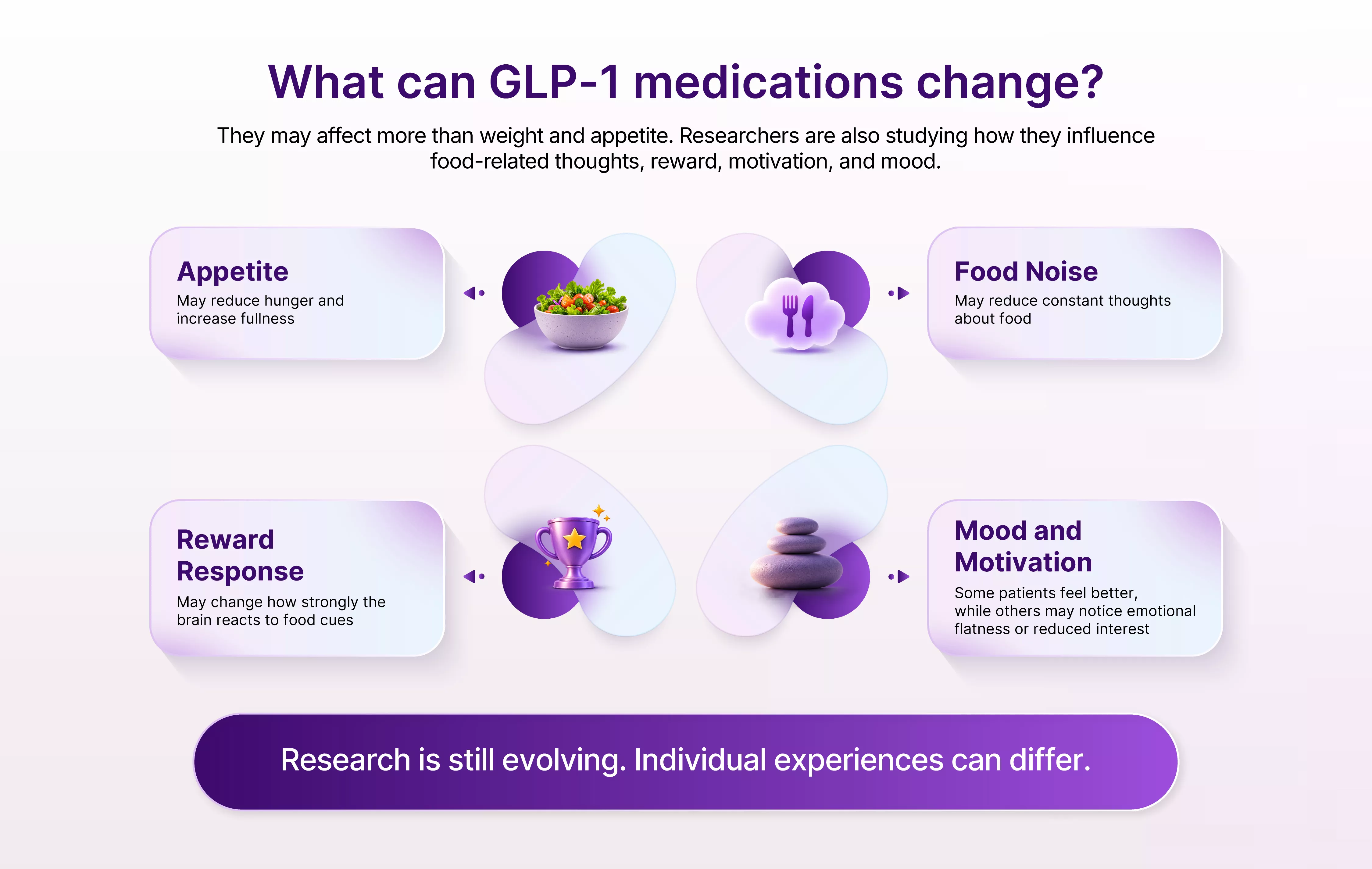
GLP-1 medications mimic hormonal signals involved in hunger, fullness, and blood sugar. They also act on brain pathways involved in reward. In a recent Psychiatric Times interview, Wayne Pratt, PhD, of Wake Forest University, described food noise mainly as a change in appetitive motivation, meaning the drive to seek out and work for food. Human brain imaging has shown that activating GLP-1 receptors changes how appetite and reward regions respond to food cues.
Two cautions apply. Pratt’s own work is in rats, and he stresses that it is not equivalent to human food noise. He also notes that what happens over years of use, and after stopping, is much less understood than what happens over months. Feeling less hungry is one experience. Feeling less mentally preoccupied with food is another, and research is still working out how the two relate.
Because these drugs act on reward pathways, scientists have asked whether they could also change pleasure, motivation, or mood. Patients describe both directions. Some feel better as intrusive cravings fade. Others feel flat or less interested in things they used to enjoy.
The FDA’s January 2026 review covered 91 placebo-controlled trials with 107,910 participants. It found no increased risk of suicidal thoughts or behavior, and no increased risk of anxiety, depression, irritability, or psychosis. The agency asked manufacturers of Saxenda, Wegovy, and Zepbound to remove the suicidal ideation and behavior warning from their labels.
A 2026 case series in Obesity Pillars described three women on high-dose tirzepatide who lost substantial weight but developed reduced motivation, emotional flatness, and loss of interest in exercise and activities they used to enjoy. The authors described the picture as distinct from a depressive episode. Symptoms improved after dose reduction, and one patient also needed bupropion. Three cases cannot show how often this happens or prove the drug caused it. They do show why motivation and enjoyment are worth asking about.
Reassuring averages across thousands of trial participants do not guarantee that an individual patient’s experience is unaffected. Trials may also enroll fewer people with active, serious psychiatric illness than a psychiatric practice sees. New or worsening depression, anxiety, loss of interest, or unusual behavior changes after starting a GLP-1 medication deserve clinical attention.
GLP-1 medications slow stomach emptying and reduce appetite and food-related reward. For someone who is already trying to restrict intake, those effects may reinforce restriction and the drive for thinness. In an October 2026 Psychiatric Times interview, Leslie Heinberg, PhD, advised careful assessment of patients with eating disorders who use these drugs. She named weight loss faster than expected, restriction, purging, and excessive exercise as the presentations that concern her most.
The scale of the issue is not small. In a 2026 JAMA Psychiatry research letter based on an online survey of 436 people with eating disorders, 32.1% had used a GLP-1 medication at some point, compared with about 15% of the general population. Roughly 10% reported misusing them.
Some early studies suggest GLP-1 drugs may reduce binge-eating symptoms. Pratt cautions that this evidence is not yet strong enough to consider them an effective treatment for binge eating disorder, and they are not approved for any eating disorder. Anyone with a history of anorexia, bulimia, binge eating, or restrictive eating should discuss it with their clinicians before starting a GLP-1 medication.
One of the most promising roles for GLP-1 medications in psychiatry has less to do with treating psychiatric symptoms and more to do with protecting the body during psychiatric treatment.
Some second-generation antipsychotics, particularly clozapine and olanzapine, can cause substantial weight gain and metabolic changes. Patients may develop:
These problems can become serious even when the psychiatric medication is working well, and weight gain is a common reason people stop taking antipsychotics.
The clearest evidence comes from a Danish randomized trial of 73 adults on clozapine or olanzapine who had early blood sugar abnormalities. After 26 weeks, those given semaglutide weighed about 9.2 kg (20 lb) less than those given placebo, had lower HbA1c, and showed no adverse effect on psychiatric stability. The trial was small, and 57 participants finished it.
Pooled studies point the same way. A 2026 meta-analysis of 8 randomized trials with 664 patients found average weight loss of about 6.7 kg and lower HbA1c, along with more nausea, vomiting, and constipation. A larger 2026 network meta-analysis of 95 trials found semaglutide produced the biggest weight reduction (about 11 kg), and only semaglutide and metformin averaged weight loss of 5% or more.
Metformin has the deepest evidence for antipsychotic-related weight gain and is far less expensive, so it is often considered first. The Toronto researchers behind the network meta-analysis describe GLP-1 medications such as semaglutide as a strong option when metformin is not enough or not tolerated, or when weight gain is substantial. The right choice depends on the patient’s metabolic picture, eligibility, medical history, and coverage.
GLP-1 medications are not FDA-approved specifically for antipsychotic-induced weight gain, so use in this setting is individualized and typically managed by a primary care physician, endocrinologist, or obesity medicine specialist working with the psychiatrist.
Researchers are studying behaviors beyond eating. A 2025 randomized trial in JAMA Psychiatry gave low-dose semaglutide to 48 adults with alcohol use disorder who were not seeking treatment. Over nine weeks, those on semaglutide drank less in a laboratory test and reported lower craving and fewer drinks per drinking day. The number of drinking days did not change. It was a small, short phase 2 trial.
The idea is biologically interesting because appetite, reward, and substance-seeking share brain pathways. But GLP-1 medications are not established treatments for depression, anxiety, schizophrenia, or substance use disorders. Larger studies, longer follow-up, and careful safety evaluation are needed.
Do not stop or change an antipsychotic or a GLP-1 medication without speaking with the clinician who prescribes it.
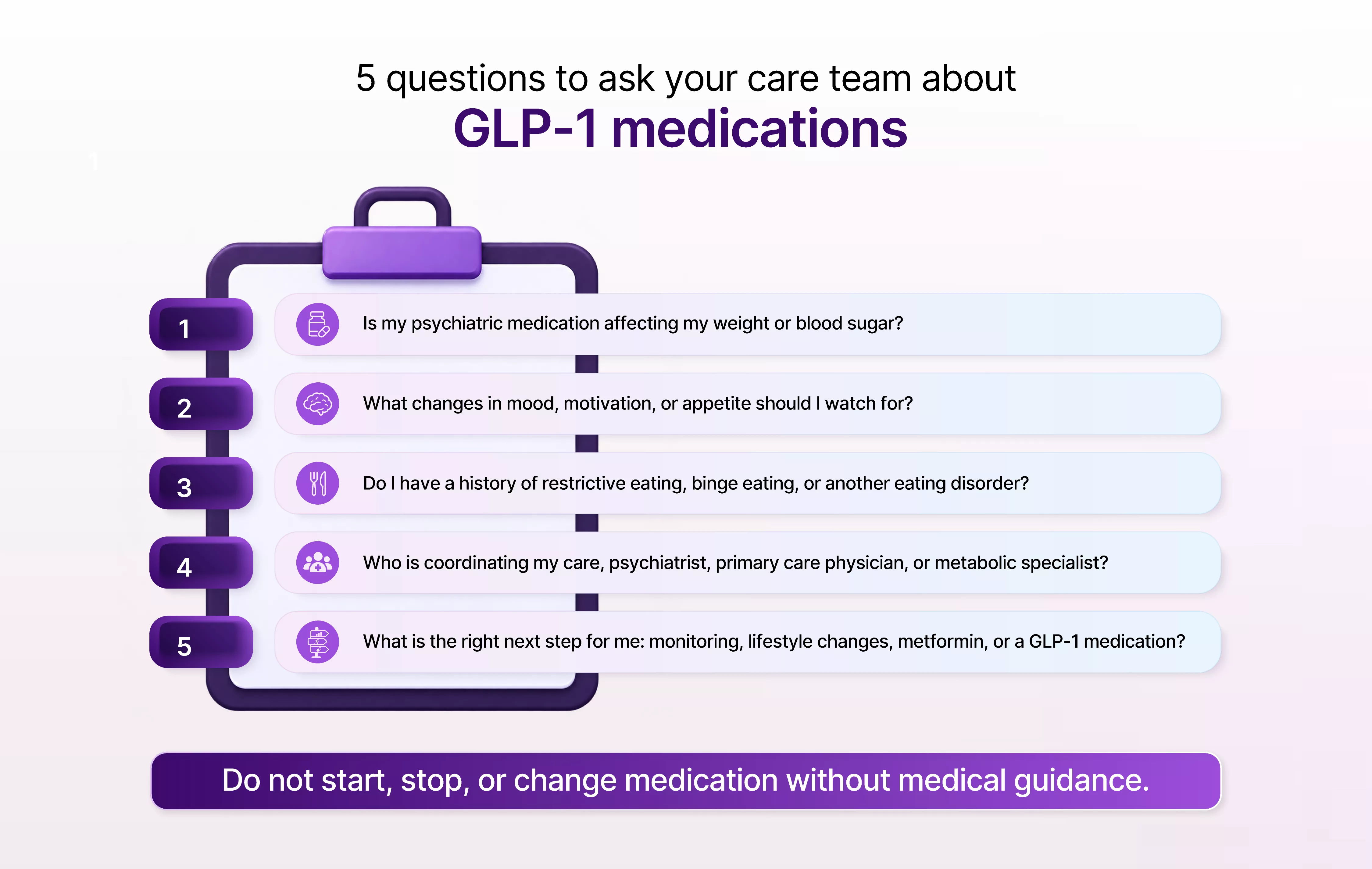
Psychiatric care should not require patients to overlook their physical health. A medication can work well for mood or psychosis while creating metabolic problems that need their own plan.
GLP-1 medications open real possibilities for people with antipsychotic-related weight gain and blood sugar changes. At the same time, questions about motivation, eating behavior, and long-term psychiatric effects deserve continued study.
The goal is not simply a lower number on the scale. It is treatment that supports the whole person.
Schedule a consultation with Dr. Ritu Goel at MindClaire.
This article is for educational purposes and does not replace individualized medical advice. Medication decisions should be made with a qualified healthcare professional.