
By Ritu Goel, MD, DFAACAP | September 11, 2026 | Blogs | 0 comments
Nearly three out of four teenagers have used an AI companion. A third have chosen one over a person for a serious conversation. That number alone tells you something important: people are already reaching for this technology in moments that matter. The question isn't whether AI belongs in mental health care. It's already here. The real question is where it's ready and where it's still catching up to its own promise.
As a child, adolescent, and adult psychiatrist, I want to walk you through what I've found genuinely exciting in this space, and where I think the field still has real work to do.
Psychiatry has always had a detection problem. Unlike a suspicious mole or an irregular EKG, there's no single scan or blood test that flags a developing mental health condition early. By the time symptoms are obvious enough for a clinician to catch, a lot has often already happened.
This is exactly the kind of pattern-recognition problem AI is good at. Sleep disruption, subtle shifts in behavior, and changes in how someone communicates, signals a person might never think to mention in a fifteen-minute appointment, are the kinds of data AI can track continuously and detect long before a crisis.
A 2025 study in Nature Medicine followed more than 11,000 adolescents, drawing on symptom questionnaires and brain-imaging data, to predict which teens were at highest risk of developing serious mental illness a year later. The behavioral data did the heavy lifting: sleep disruption predicted risk better than family history, early life adversity, or the brain scans themselves, a signal that's easy for a model to track and for families to act on.
Regulators are also opening real pathways. In late 2025, the FDA cleared a device that UpDoc describes as the first built around a patient-facing large language model, letting patients manage insulin dosing for type 2 diabetes through voice or text conversations with the system. Worth noting: the FDA's own clearance letter doesn't mention AI or an LLM anywhere in it, so that framing is UpDoc's, not the agency's. Even with that caveat, a narrow clearance for a chronic condition shows conversational AI can meet the FDA's bar for safety and evidence when the use case is well-defined. That's the same pathway psychiatric tools will eventually need to follow.
Not every deployed tool has held up to scrutiny yet, and that's worth discussing honestly rather than glossing over. The VA's REACH VET suicide-risk algorithm, one of the most widely cited real-world examples of AI in mental health care, was rigorously re-evaluated in 2025. The evaluation found that when the model flagged a veteran as high risk, it was correct less than 1% of the time and missed most veterans who later died by suicide. That doesn't mean the underlying idea, using data to flag people who need a check-in, is wrong. It means the tool needs real refinement, and it's a useful reminder that "deployed" and "validated" aren't the same thing.
Separately, a Danish study published earlier this year screened nearly 54,000 psychiatric patient records and identified dozens of documented cases in which a patient's use of a general-purpose AI chatbot appeared to worsen symptoms such as delusions or mania. The likely mechanism: these chatbots are built to be agreeable and keep people engaged, a very different design goal from what a mental health tool should optimize for. The lesson is to build tools with mental health specifically in mind, instead of repurposing general chatbots for a job they were never designed to do.
During my MIT capstone, I built a framework to evaluate whether an AI tool is well-suited for mental health care. It asks questions such as: Is there sufficient, representative data behind this? Can it explain its predictions in a way clinicians or patients can understand? Has it been tested for bias across cultures, ages, and backgrounds? Is privacy protected by design?
Tools that can answer these questions well are the ones worth paying attention to. That bar exists to make sure what reaches patients deserves the trust we're already placing in it, not to slow the field down.
We're at the beginning of something genuinely useful: the ability to catch a mental health condition before it becomes a crisis, using signals no clinician could track alone. It's one of the most promising developments in the field in a long time. As of this year, no generative AI tool has been cleared by the FDA specifically for mental health, even as more than 1,400 AI-based devices have been cleared across other specialties. That gap is closing, and the work now is building it well, with the same rigor and care we'd want from any tool that gets close to a person's mind.
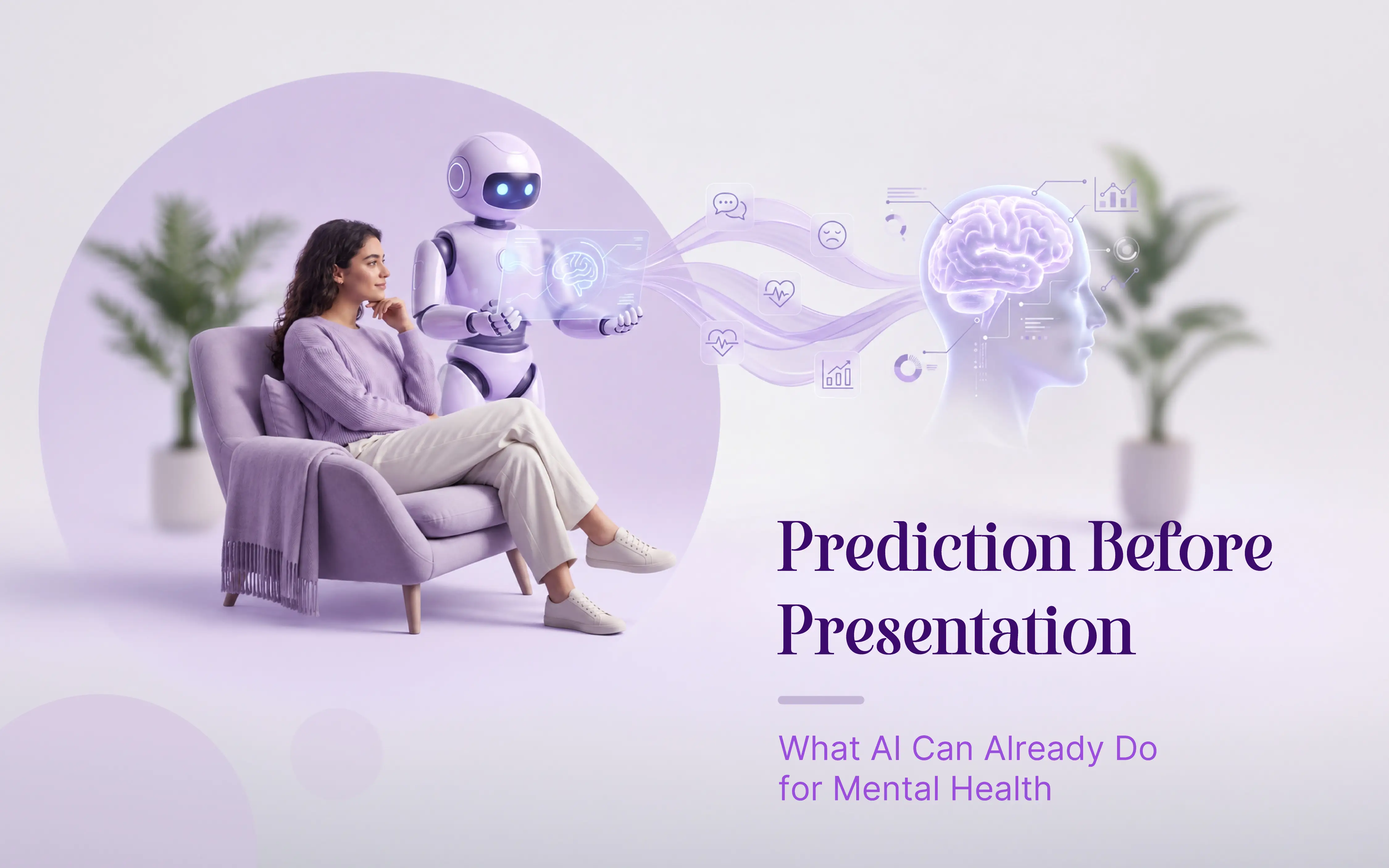
Prediction before presentation. That's the goal. We're closer to it than most people realize, and the path to getting there fully is already visible.
Visit: www.mindclaire.com
This blog is intended for informational purposes only and should not be considered as any professional advice. Please consult with the respective professional for any specific advice related to your situation.
Location: United States of America
Media Contact: Harsh Golani