
By Ritu Goel, MD, DFAACAP | August 26, 2026 | Blogs | 0 comments
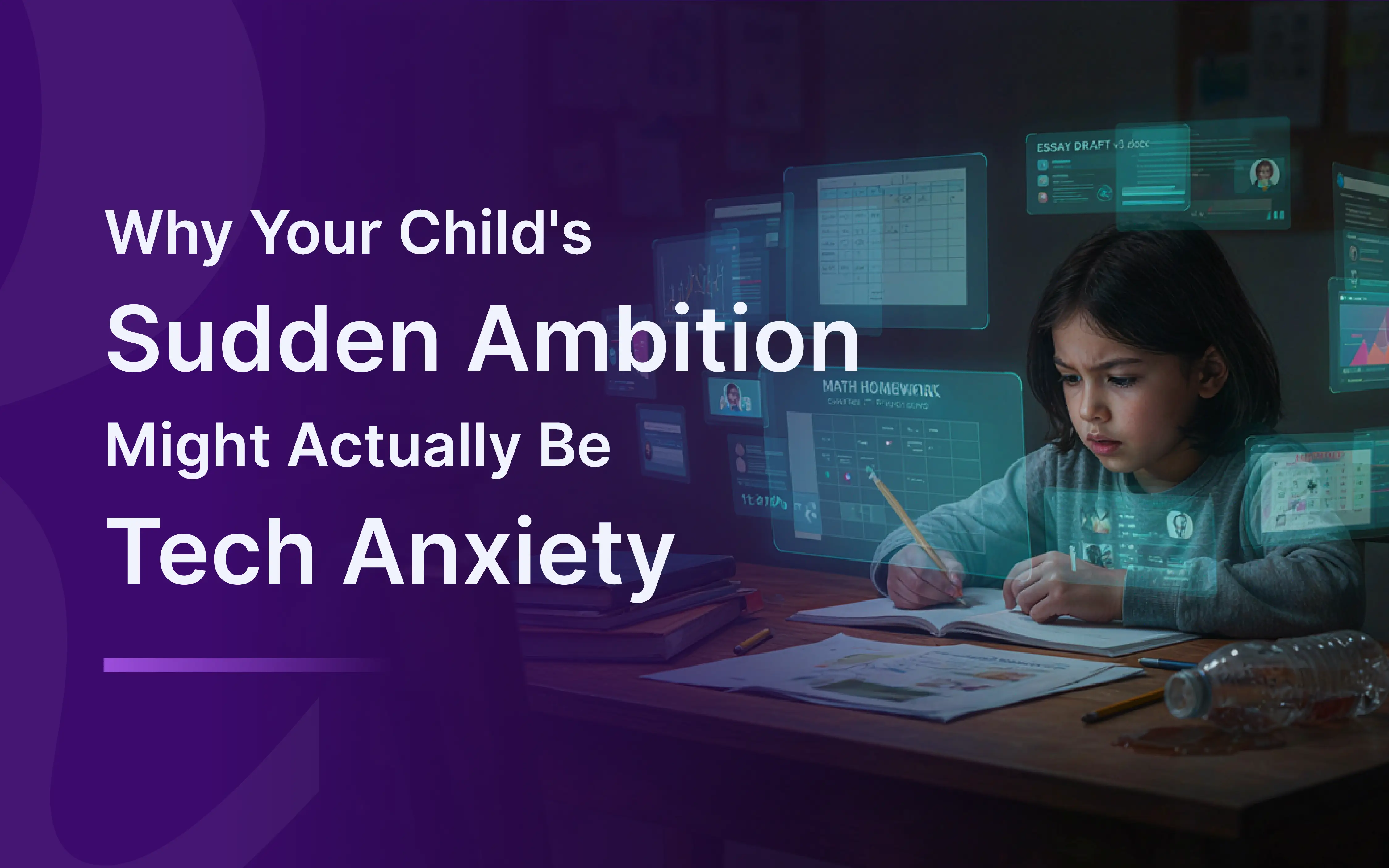
A young person announces a plan. It's total, it's expensive, it forecloses every alternative, and the family calls it ambition.
It's worth slowing down there. The giveaway is that the chosen path is often the worst available bet, the improbable athletic career, the single narrow escape route, the option with the longest odds in the room. A kid weighing probabilities doesn't land there. A kid reaching for the one place where effort still visibly produces a result lands there every time.
I see this in my practice, and I've seen it at my own dinner table.
For the past few years, the public conversation about AI has paired every efficiency gain with the removal of people. Executives have announced, at scale and often on stage, that large parts of human work are about to become unnecessary.
Whether those forecasts turn out to be right is almost beside the point for a child hearing them. Adults can defend against this kind of message. We have professional identities, track records, and the standing to draw a line just past ourselves: AI can't replace what I do. Kids have none of that. A trusted adult's uncertainty reaches them undiluted, as fact. And the response is often a plan, a foreclosure onto one narrow path, arrived at not through genuine interest but under threat.
I met a young boy, twelve years old, who'd been told by an adult he loved and trusted that there would be no jobs left by the time he grew up. Within weeks, he'd fixed on a single improbable path and asked to leave school to pursue it. He was fine in the end, because the adults around him had the training and the time to notice and course correct quickly.
That correction wasn't a given. It was an asset. Most kids don't have it.
Here's what worries me most, and it's a clinical concern as much as a cultural one.
The child who forecloses visibly, who produces a plan, makes an ask, gives you something to argue with, is a child with reserves. Generating a plan under threat takes a certain amount of intactness.
Kids without that floor beneath them mostly don't foreclose dramatically. They stop planning. No goal, no ask, nothing to push against. From the outside, that reads as apathy, disengagement, "checked out." It can look like a mood problem or a discipline problem, and sometimes it doesn't get flagged at all, because nobody thinks to ask why.
Some of what looks like adolescent amotivation may be a rational response to a future a child has been told, directly or by osmosis, is closed to them.
We ask kids about school, sleep, friends, screens. We rarely ask:
What do you think work will be like when you grow up? Who told you that? What did they say?
It takes ninety seconds. In my experience, it surfaces material that nothing else in a conversation reaches, because kids don't experience this as a symptom worth mentioning. They experience it as the weather, just how things are.
It usually also locates the source. The transmission typically happens at a dinner table, from a parent who picked something up from a keynote or a feed, said in a register that sounds like sophistication to an adult and lands as a verdict on a twelve-year-old. That parent isn't a doomsayer. They're register-blind, and that's a fixable, ordinary kind of family conversation.
The advice we hand children in response to all this: Be resilient, Be adaptable, learn to use AI, never quit.
None of that is wrong. But it's floor-dependent. For a child with real scaffolding (stable attachment, a functioning school, engaged caregivers), that advice is mostly redundant, and they'll adapt anyway. For a child without that scaffolding, the same advice becomes a bill the body ends up paying. Research on resilience in under-resourced populations has shown that high self-control can predict better outcomes on paper while quietly accelerating physical wear: faster biological aging, worse cardiometabolic markers. Striving works. It's also costly.
Resilience isn't a heroic trait some children have and others lack. It's closer to what happens when a child's support systems are actually working. It's not a replacement for those systems.
Reassurance alone doesn't work either. Telling a frightened kid the threat isn't real while the messaging around them continues is its own kind of dismissal. What actually helps is specificity and agency: what's really changing, on what timeline, and what's still within the child's control.
Two things, one small and one bigger.
The small one: Ask the question. What do you think work will be like when you grow up, and who told you that? Ninety seconds, and you'll likely learn something you wouldn't have otherwise.
The bigger one: Notice your own certainty before you hand it to a child. If you don't know how AI will reshape work, and none of us really do, say that out loud, instead of the confident version. Kids can hold uncertainty. What they can't easily hold is a verdict delivered by someone they trust.
If you're noticing a shift in your child's motivation, mood, or future-planning that concerns you, I'm happy to talk it through. Reach out through MindClaire.
Visit: www.mindclaire.com
This blog is intended for informational purposes only and should not be considered as any professional advice. Please consult with the respective professional for any specific advice related to your situation.
Location: United States of America
Media Contact: Harsh Golani